
When we built CassinoCryptoBr—an affiliate site helping Brazilian users compare crypto casinos—we faced a familiar choice: Jekyll or WordPress? WordPress is the default for many clients: familiar, easy to update, and backed by a huge ecosystem. Jekyll is static, more technical, and requires comfort with the command line. Yet we chose Jekyll. Here's why, and when it might make sense for your next affiliate project.
Data Structure for Product Comparison
Affiliate sites live or die on how well they present product information. With WordPress, you're typically storing casino data in custom post types, meta fields, or a plugin—each with its own quirks and limitations. With Jekyll, we define everything in YAML or JSON.
Each casino gets a data file: pros, cons, features, ratings, accepted cryptocurrencies, withdrawal times. Add a new casino? Create a new file. No database migrations, no plugin conflicts, no wondering whether the latest WooCommerce update will break your custom fields.
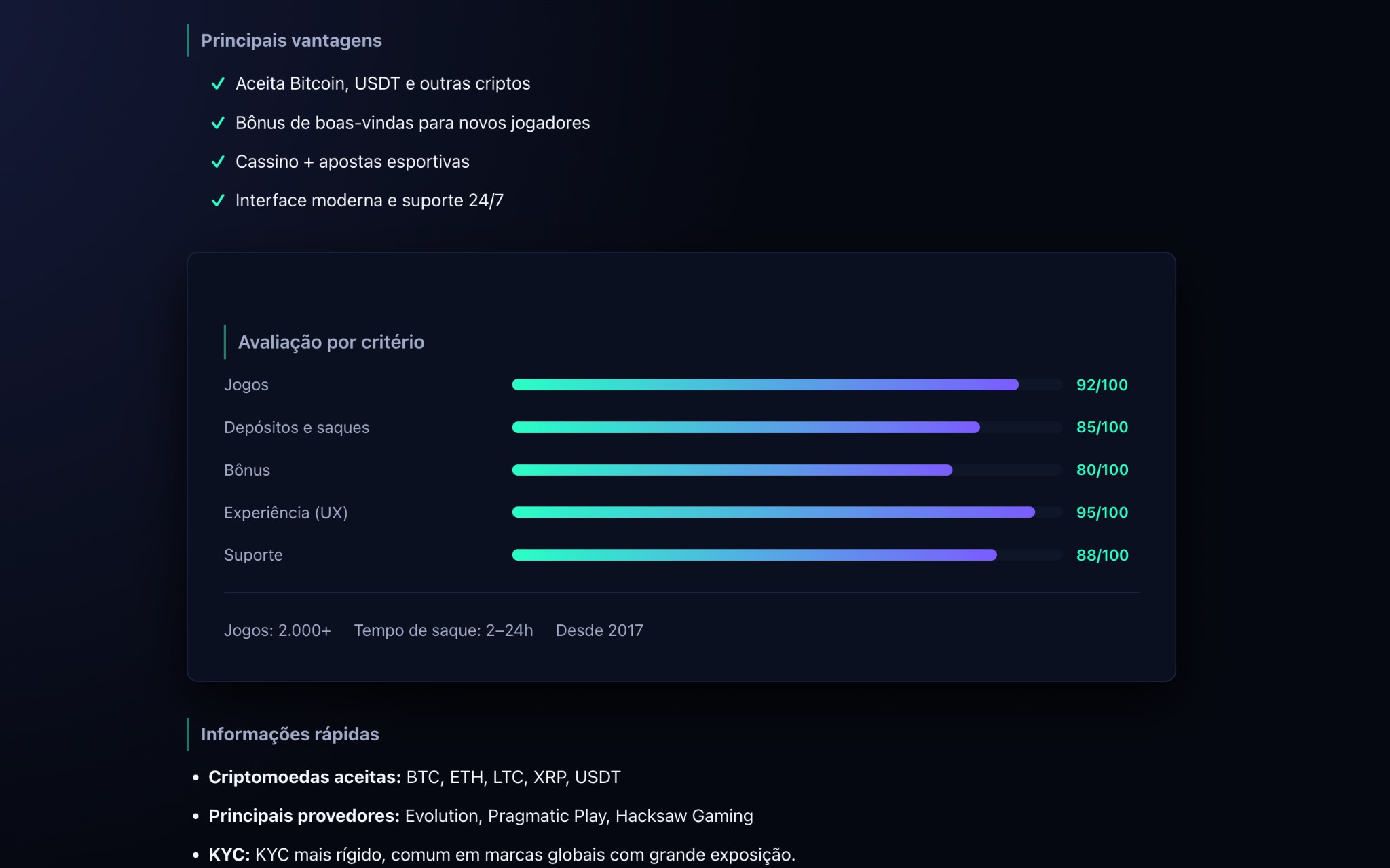
The "Resumo rápido" (quick summary) box on our landing page—featured casinos count, typical minimum deposit—pulls directly from that structured data. Same for the evaluation section: rating bars, advantage lists, and quick info are all driven by the same source of truth.

Custom Components That Don't Bore Readers
Lists of pros and cons are essential for affiliate content, but they can feel dry. Jekyll lets us build components that are engaging for readers and still scannable by search engines.
Progress bars for "Jogos" (Games), "Depósitos e saques" (Deposits and withdrawals), "Experiência (UX)"—they communicate at a glance. Checkmarks for "Principais vantagens" (Main advantages). Structured "Informações rápidas" (Quick information) with bold labels. All of this is semantic HTML rendered at build time. No JavaScript required for core content. Search engines see the same structure users do.
With WordPress, you'd rely on shortcodes, Gutenberg blocks, or a page builder. Each adds complexity and potential bloat. In Jekyll, a component is a Liquid include and a bit of CSS. Lightweight, predictable, and fully under your control.
Scalability
Adding a new casino to CassinoCryptoBr means adding a new data file and running a build. That's it. No database writes, no cache invalidation, no risk of a plugin update breaking the site.
The structure is consistent across every product page. Templates stay the same; only the data changes. That consistency pays off for SEO—Google sees a clear, repeatable pattern—and for maintenance. When we want to change how we display ratings, we change one template, not dozens of posts.
Static output also means fast load times. No PHP execution, no database queries, no dynamic rendering. Core Web Vitals tend to improve, and that matters for both users and search rankings.
Acknowledging the Downside
The main tradeoff is real: WordPress gives non-technical clients an admin UI. They can log in, edit a post, update a product, and hit publish. With Jekyll, content lives in files. Editing usually means YAML or Markdown, which many clients aren't comfortable with.
We mitigate that in a few ways. First, the data format is simple—key-value pairs, lists, nothing fancy. With a short guide, a motivated client can update a casino's features or add a new one. Second, for clients who need a UI, we can integrate a headless CMS like Netlify CMS or Forestry. They edit in a familiar interface; the output is still static files.
For affiliate sites, product data often changes infrequently. Casinos don't add new games or change withdrawal times every day. The occasional manual update or a small retainer for edits is usually enough. In that context, the SEO and scalability benefits of Jekyll often outweigh the convenience of WordPress.
Conclusion
We chose Jekyll for CassinoCryptoBr because structured data, custom components, and scalability mattered more than a point-and-click admin. If you're building an affiliate site where product comparison and search visibility are priorities, Jekyll is worth considering—even if it's more technical.
WordPress still wins when you need frequent, non-technical updates, complex workflows, or a client who insists on full self-service. But when SEO, performance, and clean data structure are the goals, a static site generator like Jekyll can give you a leaner, more maintainable foundation.